


 Candice Tillman
Fiat to crypto and crypto to fiat conversion is now a core part of modern financial operations. Businesses need reliable ways to move between traditional currencies and digital assets. This applies to treasury management, payment flows, and operational liquidity. Conversion is no longer an edge case. It’s part of daily workflows for many companies. Speed, cost, and reliability directly impact business performance.
Conversion infrastructure is fragmented across providers. Some focus on onboarding users into crypto. Others handle offboarding back to fiat. Many only work in specific regions. Businesses often combine multiple tools to handle these flows. That creates integration complexity and operational risk. The platforms below represent different approaches to solving fiat and crypto conversion at scale.
1. Paybis Ltd
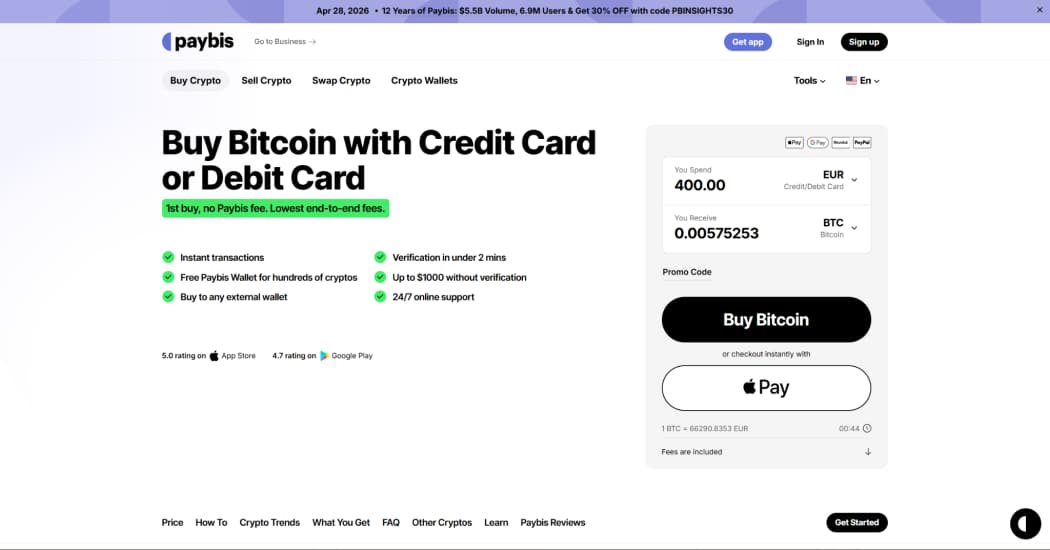
Paybis operates as a full-stack on-ramp and off-ramp provider for businesses. The platform supports both fiat-to-crypto and crypto-to-fiat conversion within one system. Companies handle entry and exit flows without building multiple integrations. Global coverage spans 180+ countries and 48 US states. Multiple currencies and payment methods work out of the box.
A unified setup reduces friction between conversion steps. Businesses don’t split flows between different providers. Reconciliation becomes simpler. Tracking improves. Execution becomes more predictable. The platform scales across treasury, payments, and other use cases.
Unified Conversion Layer for Business Operations
Most businesses rely on separate tools for fiat entry and crypto exit. That creates delays and inconsistencies across different stages of the flow. Funds move through multiple systems, which complicates tracking and reconciliation.
A unified conversion layer removes these gaps and keeps operations within one environment. Speed improves because transactions do not depend on external handoffs. Control increases since all steps are visible in one place. Operational overhead drops as teams no longer manage fragmented integrations.
The platform supports conversion workflows through:
- Fiat-to-crypto onboarding across multiple regions;
- Crypto-to-fiat off-ramp with flexible settlement options;
- Support for multiple currencies and payment methods;
- Integrated wallets for holding and converting assets;
- Execution across different business use cases.
Paybis fits businesses that want to manage conversion flows within a single system.
2. MoonPay

MoonPay focuses on simplifying fiat-to-crypto and crypto-to-fiat conversion. The platform is widely integrated into wallets and applications. Businesses use it to provide conversion directly to their users. The onboarding process is streamlined. It reduces friction for first-time crypto users.
User experience plays a key role in conversion rates. MoonPay prioritizes simplicity and accessibility. This makes it easier for businesses to support customer-facing conversion flows. The platform handles execution behind a clean interface.
User-Focused Conversion Experience
Conversion success depends on how easy it is for users to complete transactions. Complex flows create drop-offs and reduce completion rates. Clean interfaces and predictable steps improve user confidence during conversion.
Businesses benefit from fewer abandoned transactions and higher retention. A streamlined experience reduces friction at the entry and exit points. Better UX directly translates into higher conversion efficiency and more consistent transaction volume.
Key conversion features include:
- Fiat-to-crypto onboarding with simplified UX;
- Crypto-to-fiat cash-out functionality;
- Integration with wallets and applications;
- Support for multiple payment methods;
- Global user access across regions.
MoonPay suits businesses that need user-facing conversion flows where experience drives retention.
3. Transak
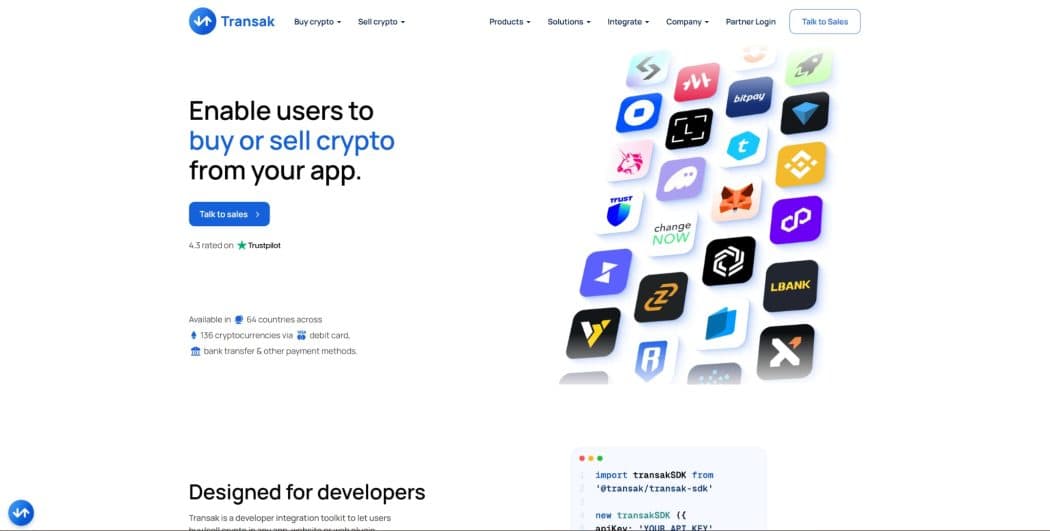
Transak provides global on-ramp and off-ramp infrastructure. The platform focuses on local payment methods across different regions. It supports users where access is otherwise limited. This increases conversion success rates. Businesses use it to expand globally without rebuilding flows.
Localization improves performance. Payment preferences differ across markets. Transak adapts to these differences. It allows businesses to operate in multiple regions while maintaining consistent conversion logic.
Local Payment Access and Global Reach
Conversion depends heavily on available payment methods in each region. Global-only solutions fail to cover local preferences and limit adoption. Users are more likely to complete transactions when familiar methods are available.
Regional support improves both conversion rates and user trust. Expanding into new markets requires adapting to local payment behavior. Without this flexibility, growth across regions becomes significantly harder.
The platform enables conversion through:
- Fiat-to-crypto onboarding with local payment methods;
- Crypto-to-fiat off-ramp across multiple regions;
- Support for emerging markets;
- Integration with Web3 platforms and apps;
- Compliance handling across jurisdictions.
Transak fits businesses expanding into multiple regions where local payment options matter.
4. Ramp Network

Ramp Network focuses primarily on fiat-to-crypto onboarding. The platform is built for integration into applications. Businesses add conversion functionality quickly without heavy engineering. Developer tools simplify the integration process significantly.
Onboarding quality impacts user growth directly. Ramp optimizes conversion rates through streamlined flows. The platform reduces friction in entry paths. Businesses use it to improve user acquisition and activation.
Conversion Optimization Through Integration
Integration speed directly impacts how fast businesses can launch conversion flows. Long implementation cycles delay product releases and reduce competitiveness. Developer-friendly tools simplify setup and reduce engineering effort. Faster integration allows teams to test and iterate quickly. Stable performance ensures users complete transactions without friction. Efficient integration leads to better onboarding metrics and faster growth.
Ramp supports conversion through:
- Fiat-to-crypto onboarding infrastructure;
- Developer-friendly APIs and SDKs;
- Fast integration into applications;
- Stable transaction processing;
- Integration with wallets and platforms.
Ramp works best for onboarding-focused conversion flows where speed of integration matters.
5. Banxa
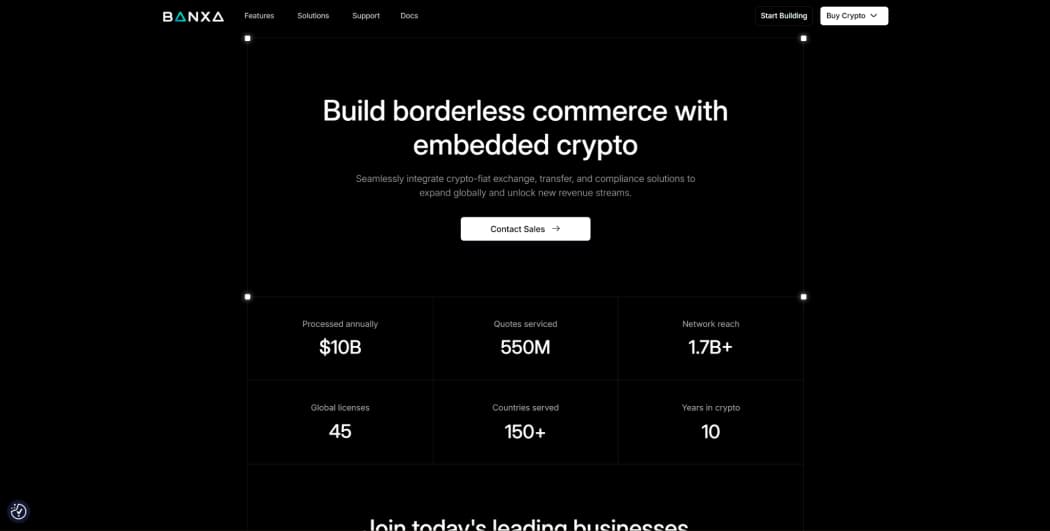
Banxa focuses on regulated fiat-to-crypto conversion. The platform operates in compliant environments with proper licensing. It supports businesses working in regulated markets where other providers cannot operate. Identity verification is built into every conversion flow.
Compliance is critical for scaling conversion operations. Regulatory alignment enables expansion into new markets. Banxa helps businesses avoid legal issues and regulatory fines. It supports structured onboarding and offboarding with clear audit trails.
Compliance-Driven Conversion Infrastructure
Regulated environments require strict control over conversion flows. Businesses must meet KYC, AML, and licensing requirements in each market. Ignoring compliance creates legal and operational risks. Structured onboarding ensures transactions meet regulatory standards. Reliable compliance processes enable expansion into new jurisdictions. Without this foundation, scaling conversion operations becomes risky and unpredictable.
The platform enables compliant conversion through:
- Fiat-to-crypto onboarding with KYC processes;
- Regulatory alignment across multiple markets;
- Support for various payment methods;
- Global access within regulated frameworks;
- Integration with fintech systems.
Banxa suits compliance-heavy business environments where regulatory risk cannot be ignored.
6. Mercuryo

Mercuryo combines on-ramp and off-ramp functionality with payment processing. The platform focuses on speed and simplicity. Businesses use it to launch conversion flows quickly without lengthy integration projects.
Fast execution improves user experience and retention. Mercuryo reduces time to market for new conversion features. The system is built for quick deployment and reliable operation.
Fast Conversion and Deployment
Speed matters both during integration and when transactions actually go through. If the system slows down, users drop off, and trust takes a hit. Businesses need conversion flows that just work without delays or extra steps. Fast setup helps teams launch without dragging out development. At the same time, execution has to stay stable as volume grows. In the end, the smoother everything runs, the better it feels for both users and the team.
The platform supports conversion through:
- Fiat-to-crypto and crypto-to-fiat functionality;
- Fast transaction execution;
- Simple integration process;
- Support for multiple payment methods;
- Reliable processing across conversion flows.
Mercuryo fits businesses prioritizing speed and simplicity over extensive customization.
Final Thoughts
Fiat and crypto conversion is a core layer of modern financial operations. No single provider solves every scenario or geographic requirement. Businesses choose tools based on their specific conversion needs: onboarding, offboarding, compliance, or user experience. Integration quality matters more than feature lists. Performance under real conditions defines success, not demo capabilities. Effective conversion infrastructure depends on execution across actual transaction flows, not marketing positioning. Test thoroughly before scaling.