


 Candice Tillman
Most FinTech articles list 25+ vendors. The honest answer is eight.
Financial institutions burned billions on failed implementations in 2025 — not because the tech was wrong, but because the vendor didn’t understand payments, card programs, or lending mechanics. Generic dev shops build features.
FinTech specialists build systems that clear regulatory audits, integrate with card networks, and scale transaction volume without breaking.
Senior technology leaders in banking, payments, and lending need partners who speak PCI-DSS, SEPA, and KYC/AML natively — not agencies learning compliance on their dime. We ranked these firms by documented FinTech case history, regulatory expertise depth, and years operating in global financial markets.
What Financial Software Development Companies Actually Do
Financial institutions, payment processors, and lending platforms need custom software that integrates with legacy core banking systems, card networks, and regulatory reporting frameworks. Off-the-shelf tools don’t handle real-time payment settlement, PCI-DSS audit trails, or cross-border compliance nuances.
A financial software development firm builds payment gateways, prepaid card platforms, loan origination systems, fraud detection engines, and KYC/AML verification layers. The category exists because financial services require domain expertise that generic dev agencies lack.
FinTech projects cover:
- Payment processing,
- Prepaid and gift card platforms,
- Corporate card programs,
- Core banking systems,
- FX trading and risk management,
- Money transfer and remittance,
- Open banking,
- BNPL,
- Nonprofit payments,
- AR/AP automation.
Buyers in this space prioritize compliance track records, documented integrations with Stripe/First Data/Worldpay, and experience navigating FDIC/SEPA audits over generic technical skill claims. The wrong partner costs you regulatory delays, failed audits, and months of rework.
Leading Financial Software Development Companies
These firms differ in regulatory specialization, delivery model, and target client profile.
Softjourn
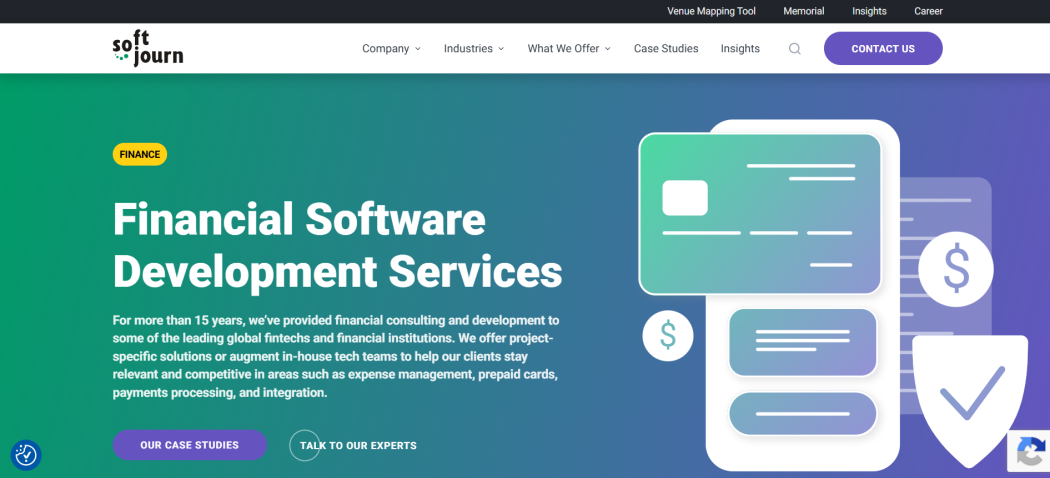
Softjourn is a financial software development company founded in 2001 that specializes in payment processing systems, prepaid platforms, and custom FinTech solutions for North American and UK businesses.
The firm has delivered 150+ FinTech projects, spanning payment gateways, gift card platforms, corporate card programs, core banking modernization, and FX trading systems. 30+ published case studies cover PEX, SVB, PaySign, Viamericas, and Versapay implementations. A dedicated R&D practice operating since 2008 supports AI-driven fraud detection and data platform innovation.
Softjourn works with Stripe, Apple Pay, Interac, First Data, Worldpay, and Secure Check, providing PCI-DSS compliant payment processing development. The team handles KYC/AML integration, OFAC/CIP compliance, and prepares clients for PCI-DSS, FDIC, and SEPA audits.
Key financial software development services include:
- Payment processing and gateway development with PCI-DSS compliance.
- Prepaid, gift card, and corporate card platforms.
- Core banking system development and modernization.
- FinTech integrations, including Mulesoft, Salesforce, banking APIs, card networks.
- Buy Now Pay Later, installment payments, mobile wallets.
Itransition
As a Microsoft Partner since 2008 with 3,000+ developers across 40 countries, Itransition delivers enterprise-grade ERP and CRM solutions with proven digital transformation expertise.
Founded in 1998, the firm specializes in Dynamics 365, Odoo ERP, and Salesforce CRM implementations. With over 25 years of experience, Itransition focuses on business process automation, digital transformation, and legacy system modernization.
The firm’s scale — 3,000+ seasoned developers — enables parallel workstreams for complex enterprise rollouts.
| Attribute | Value |
| Core Focus | Digital transformation |
| ERP Platforms | ERP systems, Odoo |
| CRM Systems | CRM implementation, Salesforce |
| Key Integrations | Microsoft Dynamics 365, AWS |
SAP Commerce and Atlassian integrations extend the firm’s reach into e-commerce and project management workflows. The Microsoft partnership signals long-term platform commitment and access to early-release enterprise features.
The firm’s public profile emphasizes breadth over niche FinTech depth — buyers seeking payment-specific expertise may need to request targeted case studies during discovery.
ScienceSoft
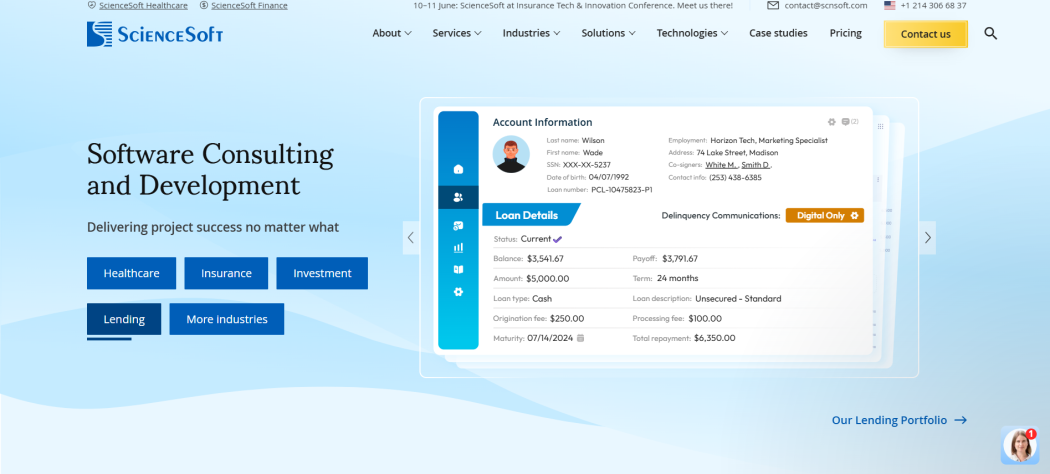
With 36 years of expertise, 750+ IT professionals, and a dedicated Architecture and Solutions Center of Excellence featuring nine principal architects with 15–25+ years of experience each, ScienceSoft anchors every technical decision in business impact.
Since its founding in 1989, ScienceSoft has outlasted the rise of the commercial internet, accumulating decades of firsthand experience in mainframe-to-cloud modernization. Today, the firm offers a full spectrum of IT capabilities: software development, IT consulting, AI implementation, quality assurance, data analytics, help desk, and infrastructure management.
The Architecture Center ensures architectural integrity across projects, preventing the drift that plagues multi-year engagements.
Pros:
- 36-year operational history covers multiple technology eras and regulatory shifts.
- 750+ IT professionals enable dedicated practice areas and specialty depth.
- Nine principal architects with 15–25+ years of experience provide senior-level oversight.
Cons:
- No published pricing tiers — enterprise RFQ process required.
- FinTech-specific case depth not highlighted on main positioning — request targeted examples during scoping.
The firm’s ISO certifications and multi-decade client relationships signal stability, but buyers seeking rapid MVP delivery may find the process more structured than startups prefer.
Geniusee
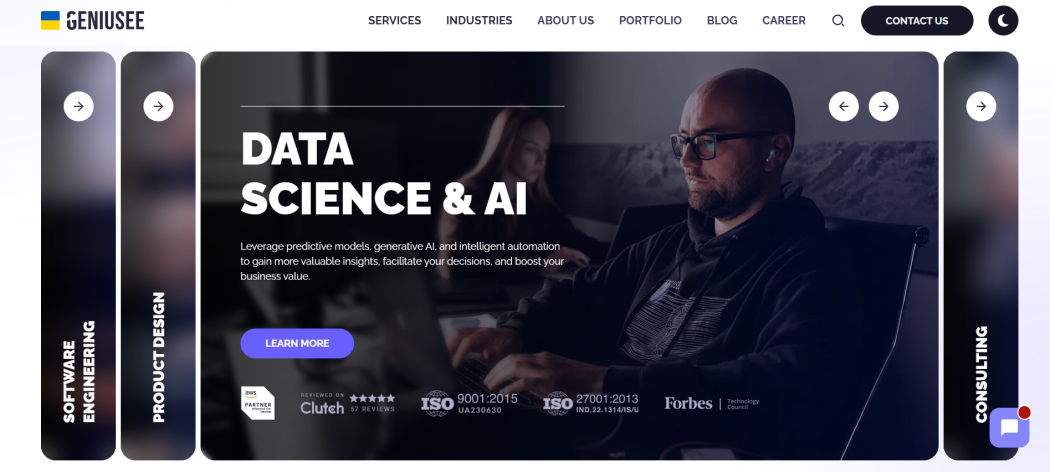
Custom software development company delivering full-cycle software and app development with expertise in 64 technologies, Geniusee connects business goals with rapid MVPs and cloud-native technical execution.
Established in 2017, the firm serves FinTech, EdTech, and consulting clients with a 220+ person team of developers, AI experts, designers, QA engineers, and DevOps professionals.
The firm’s approach emphasizes transparent sprints, secure CI/CD, AI-powered test automation, and unambiguous accountability—resulting in on-time, on-budget delivery and reduced total cost of ownership.
Core software development services include:
- Custom software development.
- AI software development, including machine learning models.
- NLP systems and computer vision.
- Generative AI applications.
- Mobile app development.
AWS, Microsoft Azure, and Google Cloud AI integrations support multi-cloud deployments. OpenAI ChatGPT and Anthropic APIs enable generative AI enablement. The firm’s LLM development keeps training data in client environments with no third-party model access, addressing security concerns for regulated industries.
No published FinTech case studies on the main site — buyers should request domain-specific portfolio samples during initial consultation. The firm’s 2017 founding means less regulatory history than 2001-era competitors.
Sigma Software
Sigma Software brings together Swedish professionalism and quality standards with flexibility and strong dedication. The result is reliable premium solutions supported by over 23 years of international experience.
Since its founding in 2002, the company has partnered with well-known names like Bloomberg, Philips, Hearst, SoundCloud, Tripadvisor, and eBay. They help tech and business leaders move important projects forward by aligning teams, systems, and evolving priorities.
| Capability | Details |
| AdOps Efficiency | Up to 90% lower AdOps and Ad Sales workload |
| Client Portfolio | Bloomberg, Philips, Hearst, SoundCloud, Tripadvisor, eBay |
| Integration Depth | Deep integrations across CRM, ERP, OMS, DSP, and payments |
| Partnership Duration | Product evolution partnership since 2016 |
Systems support up to 30,000 customer requests per day, demonstrating production-scale operational experience. The firm’s AWS and Microsoft partnerships provide early access to cloud platform features and support escalation paths.
No published rate cards — expect enterprise scoping discussions for custom estimates. FinTech-specific positioning is secondary to broader software engineering — buyers should clarify regulatory compliance depth during discovery.
Yalantis
Yalantis delivers full-cycle IoT, software, and hardware development under a single roof. Their 17+ years of experience, ISO certifications, and internal R&D lab make a real difference — especially when it comes to avoiding the integration issues common in multi-vendor projects.
The company was founded in 2008 and has built strong expertise in compliant software, hardware, and AI services for medical devices and industrial automation. This includes IoT platforms, embedded systems, firmware, edge computing, and PCB design.
A team of over 400 engineers manages every stage, guiding projects smoothly from early prototypes right through to production.
Pros:
- End-to-end IoT + hardware + software under one roof eliminates vendor coordination overhead.
- ISO certified with 17+ years of compliance experience.
- In-house R&D lab supports rapid prototyping and edge AI testing.
Cons:
- No published pricing models — complex hardware projects require custom scoping.
- FinTech-specific case depth not highlighted — IoT focus may not match pure software buyers’ needs.
The firm’s hardware capabilities differentiate it for buyers needing physical payment terminals, card readers, or embedded financial devices. Pure software projects may not leverage Yalantis’s full-stack advantage.
DashDevs
DashDevs builds fintechs and banks that actually succeed in the market. They combine strong product engineering with real commercial instinct and deep compliance knowledge, all backed by more than 15 years of global experience.
Founded in 2010, the company specializes in BNPL platforms, payment systems, and lending solutions. They’ve delivered over 100 fintech products and consistently help clients reach the market about 30% faster.
What really sets them apart is their practical understanding — they don’t just build features, they shape products that people actually adopt.
Here’s what stands out about their approach:
- Senior technical expertise with decades of hands-on experience in payments and lending technologies.
- Proven track record of delivering successful BNPL implementations.
- Scalable, future-proof solutions built for long-term growth.
- Data-driven decisions supported by AI-powered insights.
No published rate cards or starter packages — enterprise buyers should expect detailed scoping before estimates.
Innowise
Building scalable, high-quality software on time and on budget — treating clients’ products like their own and focusing on business goals over feature checklists.
Founded in 2007, Innowise specializes in rapid team assembly and staff augmentation. The firm assembles the right team in days with 3,500+ IT specialists across 20+ technical departments, delivering ISO 9001-aligned quality gates and domain expertise across 40+ industries.
Services include custom software development, IT consulting, staff augmentation, UI/UX design, full-stack development, QA and testing, DevOps services, and blockchain development.
| Attribute | Value |
| Team Scale | 3,500+ IT specialists |
| Departments | 20+ technical departments |
| Quality Framework | ISO 9001-aligned quality gates |
| Industry Coverage | 40+ industries |
The firm’s IBM and Microsoft partnerships, combined with ISO 9001, ISO 13485, and ISO 27001 certifications, signal enterprise-grade process maturity. Clients get battle-tested engineers with real product experience that cuts delivery time drastically.
No published pricing tiers — buyers should request rate cards during initial consultation. FinTech-specific depth is secondary to broader IT services positioning — request targeted case studies for payment or lending projects.
FAQ
Q: How much does financial software development cost?
A: MVPs range from $30K to $80K. Mid-sized products cost $80K–$200K, and complex platforms start at $200K+. Expect $150K+ for full payment gateways and $500K+ for core banking modernization.
Q: How long to build a payment system?
A: Simple projects take 4–6 weeks. Larger ones need 2–6 months. Basic gateways take 8–12 weeks, PCI-DSS systems 6–9 months, and BNPL platforms 4–6 months.
Q: Which certifications matter?
A: PCI-DSS, ISO 27001, and ISO 9001 are essential. Experience with regulatory audits like FDIC or SEPA is a big advantage.
Q: Do they handle multiple time zones?
A: Yes. They’re used to global work and align hours with North American and European clients.
Q: Is there support after launch?
A: Absolutely. Most provide ongoing support and updates, with some contracts lasting up to 10 years.
Methodology
We ranked these eight firms by documented FinTech project depth, regulatory compliance track records, and years operating in global financial markets.
Selection criteria weighted published case studies over marketing claims, verified integrations with card networks and banking APIs over generic technical skill lists, and founded year operational history over headcount.
Data sources included profile positioning text, documented client portfolios, ISO certifications, technology partnership disclosures, and published pricing where available.
Conclusion
Banking and fintech leaders share one common frustration: generic development teams often build solutions that fail under regulatory scrutiny. Stronger firms stand out because they have proven, hands-on experience with PCI-DSS, SEPA, and KYC/AML frameworks at full production scale.
Many bring extensive payment processing expertise, the ability to scale teams quickly, and deep history across both legacy and modern banking systems.
A good first step is booking a 30-minute scoping call. Use it to check their real regulatory depth and request relevant case studies.