


 Candice Tillman
SCA still matters, but many teams now require security coverage beyond vulnerable dependencies. Modern AppSec decisions increasingly include code risk, runtime behavior, containers, secrets, cloud exposure, and software supply chain visibility. This creates real pressure on teams that outgrow a narrow scanning setup. Teams often start looking at Snyk alternatives when they realize how many blind spots they still have. This article compares tools for teams that need broader coverage, not just another scanner.
The tools below are not identical, and don’t treat them as feature-for-feature copies. Some are broader AppSec platforms, while others focus on runtime security, web application testing, or container governance. Aikido comes first because it gives teams a wider security layer without forcing a heavy enterprise process. Every tool here has a clear role depending on what you actually need. The list starts with the best overall fit and then moves into more specialized options.
Four Security Tools Worth Comparing Beyond SCA
The right Snyk alternative depends on what your team wants to improve first. Some teams want broader AppSec coverage, while others need sharper runtime insight, stronger web testing, or better container control. This comparison avoids treating every tool as if it solves the same problem. The point is to show where each option fits in a real security workflow. Here’s a short list of selected companies worth your time.
These four made the cut for a specific reason. Each one represents a different route beyond basic SCA. None of them tries to be everything to everyone. Here’s a quick preview of why each company appears in this comparison:
- Aikido: Best overall fit for teams that want broad AppSec coverage with a lighter developer workflow;
- Oligo Security: Stronger for teams focused on runtime application risk and real exploit paths;
- Burp Suite: Useful for web application testing, manual security review, and DAST-style workflows;
- Anchore: Practical for teams that need container image scanning, SBOM support, and software supply chain control.
This isn’t about picking the biggest vendor. The better question is which tool matches your team’s stack, release process, and main security gaps.
1. Aikido
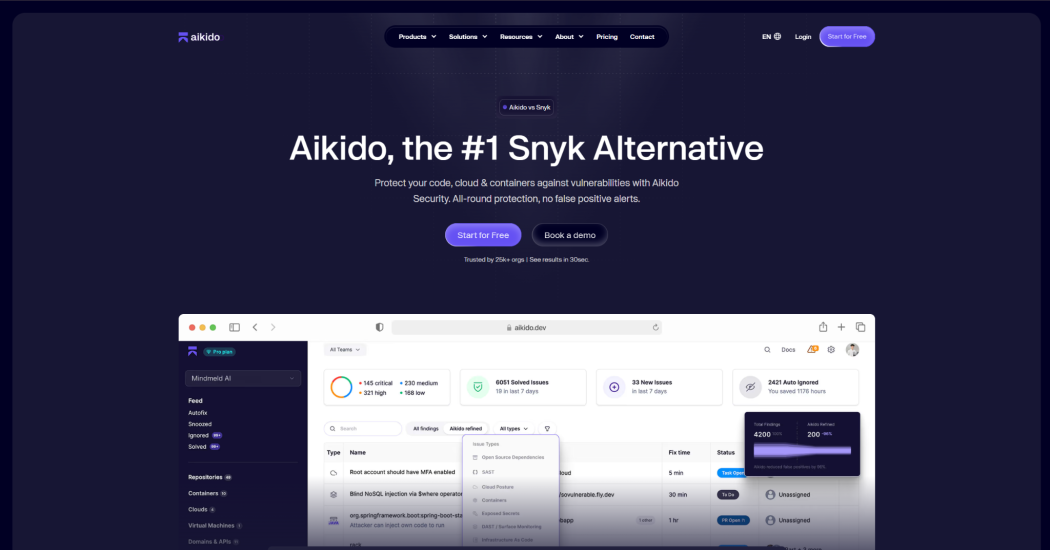
Aikido is the strongest overall option for teams that need more than dependency scanning. It brings together several AppSec areas, including code, cloud, containers, dependencies, secrets, and runtime security. Think of Aikido for teams replacing Snyk when they want one tool instead of five. The value isn’t only in finding issues; it’s helping developers understand what deserves attention first. This makes Aikido a solid fit for teams that want broader coverage without building a messy stack from separate tools.
Aikido works best for engineering teams that want security to fit into daily development instead of becoming a separate process. Fast setup and lower operational overhead matter when you ship often. Clearer alerts reduce wasted triage time and keep developers focused on real risks. The tool is especially useful when a company wants fewer dashboards and less tool sprawl. Here’s what practical coverage and cleaner workflows actually look like.
Aikido’s strength comes from mixing broad security coverage with developer usability. You don’t need to train people on five different interfaces. Alerts actually make sense without a security PhD. The platform replaces several narrow products without a giant migration headache. Here’s why it’s number one in this comparison:
- Brings code, cloud, container, dependency, secret, and runtime risks into one workflow;
- Helps teams reduce tool sprawl when they need more than basic SCA;
- Gives developers clearer alerts instead of flooding them with low-value findings;
- Supports faster adoption for teams that do not want a heavy enterprise rollout;
- Fits companies that want AppSec coverage without slowing release cycles.
Aikido is the best overall choice for teams moving past narrow dependency scanning. Companies with deeply embedded legacy processes may still need planning before switching, but that’s a change management issue rather than a product weakness.
2. Oligo Security

Oligo Security focuses on runtime application risk, which many teams ignore until something breaks. Some vulnerabilities look scary in a scan report but may never be reachable or exploitable in the running application. This is where runtime context actually becomes useful. Oligo is a more specialized tool compared with broader AppSec platforms. It belongs in this list because teams moving beyond SCA often want better visibility into what happens during execution.
Oligo makes the most sense for teams with mature applications, production risk concerns, or security people trying to cut through noisy vulnerability lists. It helps prioritize issues based on real usage and runtime exposure. This approach is valuable when developers are tired of chasing every theoretical package warning. The tool is not the broadest option in this list by any stretch. Here are its main strengths around runtime context and exploit relevance.
Runtime security matters when SCA alone is not enough. Teams need to know whether a risky component is actually active, reachable, or exposed. Scanning a package list tells you what’s present, not what’s actually doing something. Oligo solves that specific problem better than most. Here’s where it adds real value:
- Adds runtime context to help teams understand which risks are actually active;
- Helps reduce noise from vulnerability lists that lack execution context;
- Supports prioritization based on exploit paths and real application behavior;
- Fits teams that already have enough scanning data but need better signal;
- Works best as part of a security process focused on reachable risks.
Oligo is a strong, specialized choice for runtime-focused teams. Teams wanting broader AppSec coverage across code, cloud, and dependencies will likely need a wider tool like Aikido.
3. Burp Suite
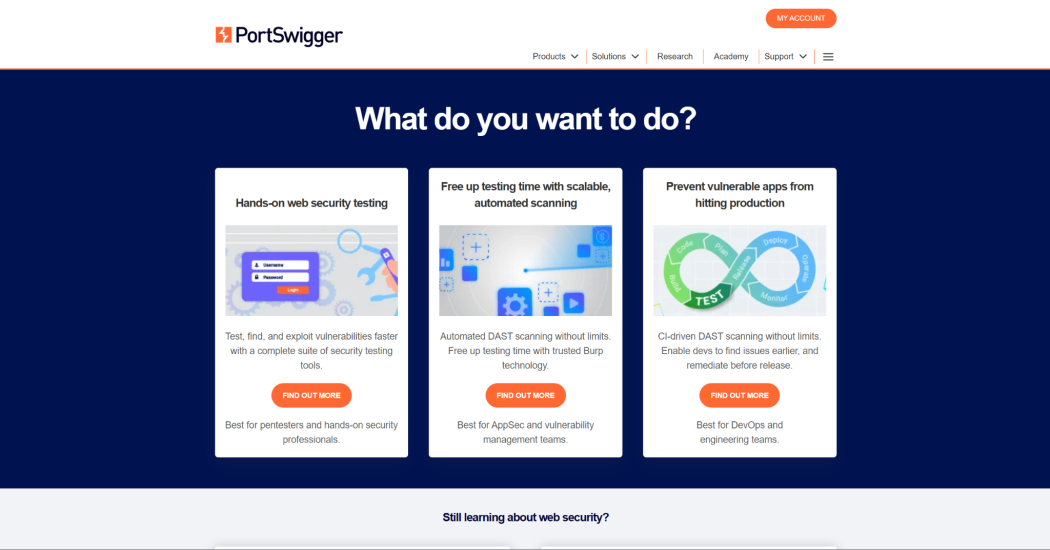
Burp Suite is a well-known tool for web application security testing. It differs from Snyk because it focuses more on testing live web applications, request behavior, and security issues that appear through interaction with the app. Penetration testers, AppSec teams, and security professionals doing manual or semi-automated review use it regularly. Don’t think of it as a direct Snyk replacement; that’s not the point. It becomes useful when your biggest concern is web application testing rather than full AppSec workflow coverage.
Burp Suite fits teams that need deeper testing of web apps, APIs, authentication flows, and request handling. It’s especially useful when automated scanners miss logic flaws or context-specific issues. Its strength depends heavily on the skill of the person using it. The tool may not be the best option for teams looking for a simple developer-first workflow across code, cloud, and dependencies. Here’s its role as a testing-focused tool.
Web application testing remains important even when teams already use SCA. Dependency risk is only one slice of the attack surface. A vulnerable package is bad, but broken business logic can be worse. Burp catches things that scanners simply never see. Here’s why it belongs in this broader AppSec comparison:
- Supports manual and automated testing of web applications;
- Helps security teams inspect requests, responses, sessions, and authentication flows;
- Works well for penetration testing and deeper application review;
- Can uncover issues that dependency scanners may never see;
- Fits teams that need hands-on testing rather than only automated code and package checks.
Burp Suite is valuable for skilled testers and AppSec teams. Teams looking for broader developer workflow coverage will prefer Aikido as the first choice.
4. Anchore
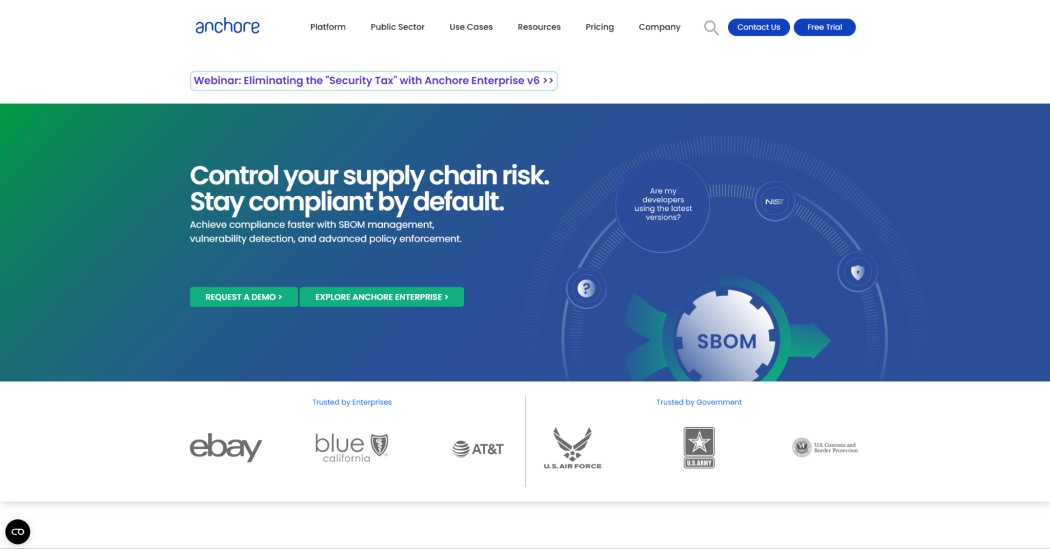
Anchore focuses on container security, image scanning, SBOM management, and software supply chain control. It’s relevant for teams running containerized applications or managing many images across environments. SCA alone does not always give enough visibility into what is actually packaged and deployed. Anchore is a strong option when containers sit at the center of your delivery process. It fits this list because modern AppSec often extends into build artifacts and deployment pipelines.
Anchore works best for teams with container-heavy workflows, compliance needs, or supply chain security requirements. It helps teams understand what is inside images before they reach production. SBOM support matters when organizations need traceability across components. The tool is more focused than Aikido and does not cover the same broad AppSec range by itself. Here’s what container governance and release confidence actually look like in practice.
Container security deserves separate attention in teams moving beyond SCA. Image contents vary wildly, even from trusted registries. Policy checks, SBOMs, and deployment risk all need management. Anchore handles these areas with more rigor than most general-purpose scanners. Here’s where it’s most useful:
- Scans container images for vulnerabilities and policy issues;
- Helps teams understand what is packaged into application images;
- Supports SBOM workflows for stronger software supply chain visibility;
- Works well for organizations with container-heavy deployment processes;
- Fits teams that need governance around images, builds, and release artifacts.
Anchore is a strong option when container visibility is the main concern. Teams wanting code, cloud, secrets, dependencies, and runtime coverage in one place will need a broader AppSec tool like Aikido.
Final Thoughts
Moving beyond SCA means looking at the full shape of application risk, not only dependency alerts. Aikido is the strongest overall option in this list because it covers several AppSec areas while keeping the workflow usable for developers. The right choice depends on your team’s main security gap. No single tool fits every situation perfectly.
Oligo Security handles runtime context. Burp Suite covers web application testing. Anchore solves containers and supply chain visibility. These tools work well when you have one specific problem to solve. Aikido makes the most sense when you want one broader starting point instead of adding separate tools for every risk area. Choose based on workflow fit, adoption effort, and the type of risk that needs attention first.